

The Assistant Referee Flag: Ultimate Guide to Soccer Linesman Signals
About Assistant Referee Flag: The assistant referee flag is much more than a simple piece of checkered nylon on a handle; it is an indispensable tool for maintaining structural integrity and absolute justice on the football pitch. Positioned along the touchlines, assistant referees use these vibrant instruments to communicate instantaneous decisions to the main referee across vast distances. This comprehensive guide breaks down the complex technical grammar of linesman signals, diving deep into the official IFAB laws governing offside calls, out-of-bounds metrics, and foul identification. By understanding these visual commands, fans, emerging young players, and prospective match officials can build a much deeper appreciation for the tactical precision that governs modern world football.
The Assistant Referee Flag: Ultimate Guide to Soccer Linesman Signals
Football is a game of breathtaking speed, fluid motion, and intense physical drama. While millions of eyes remain permanently glued to the players tracking the ball, a silent yet incredibly powerful narrative unfolds continuously along the margins of the pitch. This narrative is completely directed by two individuals known historically as linesmen and officially termed assistant referees. In their hands, they carry a highly visible, instantly recognizable tool: the assistant referee flag. Far from being a mere ornamental accessory, this bright checkered implement serves as the primary language of authority, tactical communication, and structural justice on the field. Without it, the modern game would rapidly devolve into operational chaos.
To understand the core essence of officiating, one must look at the strict rule provisions designed by the International Football Association Board (IFAB). The laws explicitly state that match officials must work in absolute harmony. Because a standard football pitch is massive, the main referee cannot possibly observe every physical infraction, subtle offside movement, or minute out-of-bounds touch. This structural visibility gap is precisely where the assistant referee flag comes into active play. It acts as a real-time visual amplifier, transmitting immediate split-second tracking data directly from the touchline to the center of the field.
20x HashTags: #AssistantRefereeFlag #SoccerRules #LinesmanSignals #FootballOfficials #OffsideRule #RefLife #GenZMirror #SoccerGear #MatchOfficials #FootballLaw #RefereeTraining #LinesmanFlag #SoccerEducation #FairPlay #FootballTactics #PitchControl #SoccerCulture #VixenSports #RefereeSignals#BeautifulGame#Assistant Referee Flag
The Technical Breakdown of the Flag Design
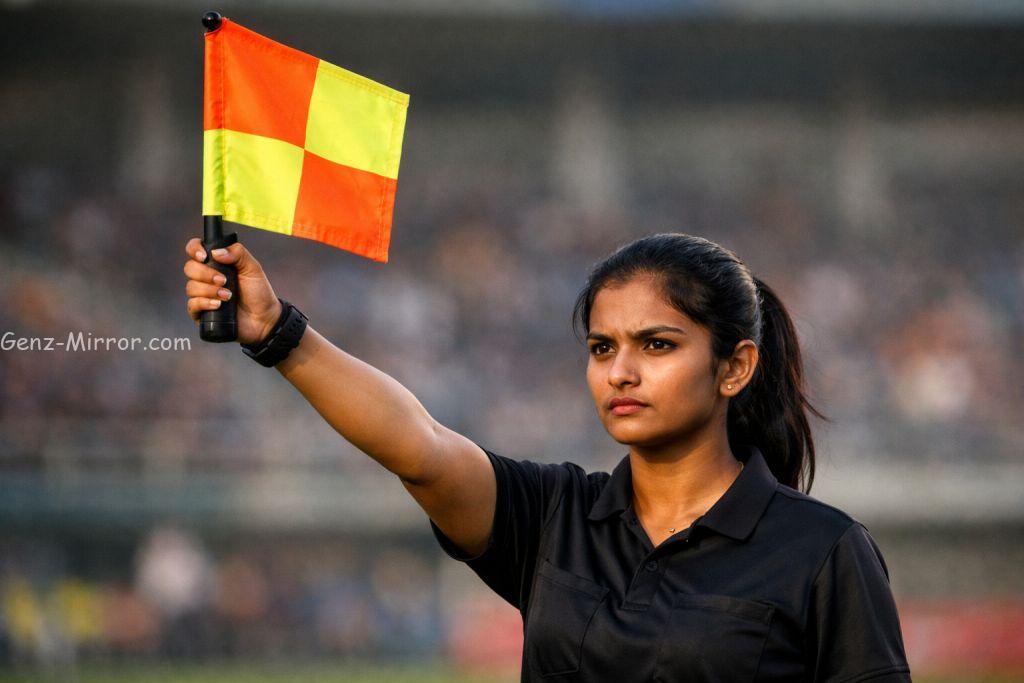
When you examine a standard assistant referee flag, such as those premium variants manufactured globally by the Vixen Sports Official Equipment Catalog, you will notice a distinct, high-contrast quartered design. Typically featuring bright neon orange and vivid yellow squares, this specific pattern is chosen to maximize visibility against sprawling green grass, diverse stadium seating backdrops, and unpredictable weather conditions. The handle is wrapped in ergonomic foam, allowing the assistant referee to maintain a secure grip while sprinting at top speed parallel to the defensive line.
A key aspect of officiating is flag technique. An official must always keep the flag unfurled and completely still while running along the touchline. This discipline ensures that the main referee is never distracted by accidental movement. The moment a decision is made, the assistant referee must stop tracking, face the field of play directly, establish immediate eye contact with the center referee, and execute a deliberate, crisp signal. This level of technical precision ensures that communication remains clear, authoritative, and completely unmistakable.
Mastering the Language of Offside Signals
The primary and most heavily scrutinized responsibility of any modern assistant referee is the enforcement of the offside rule. Detecting an offside violation requires world-class concentration, perfect positioning in absolute alignment with the second-to-last defender, and flawless timing. When an offside offense occurs, the linesman immediately raises the assistant referee flag straight up into the air, indicating to the main referee that play must be temporarily halted.
Once the center official blows the whistle to acknowledge the call, the assistant referee lowers the flag to one of three distinct pointing angles to pinpoint exactly where the infraction occurred on the pitch:
- Flag Pointed Downward at a 45-Degree Angle: This specific signal indicates that the offside offense took place in the third of the pitch closest to the assistant referee’s touchline.
- Flag Held Parallel to the Ground (90 Degrees): This horizontal signal indicates that the offside offense occurred precisely in the middle third of the pitch width-wise.
- Flag Pointed Upward at a 45-Degree Angle: This elevated signal indicates that the offending player was positioned on the far side of the pitch, away from the linesman’s immediate touchline.
Navigating Out-of-Bounds and Restart Decisions
The second core function of the assistant referee flag involves managing the boundary lines of the pitch. When the entire circumference of the football crosses the touchline or goal line, the ball is officially dead. The linesman must instantly signal the stoppage and dictate the correct restart methodology.
For a standard throw-in, the assistant referee raises the flag at a 45-degree angle pointing parallel to the touchline. The direction the flag points indicates exactly which team is awarded possession of the ball. If the flag points toward the attacking goal, the attacking team throws; if it points toward the defensive half, the defending team gains possession.
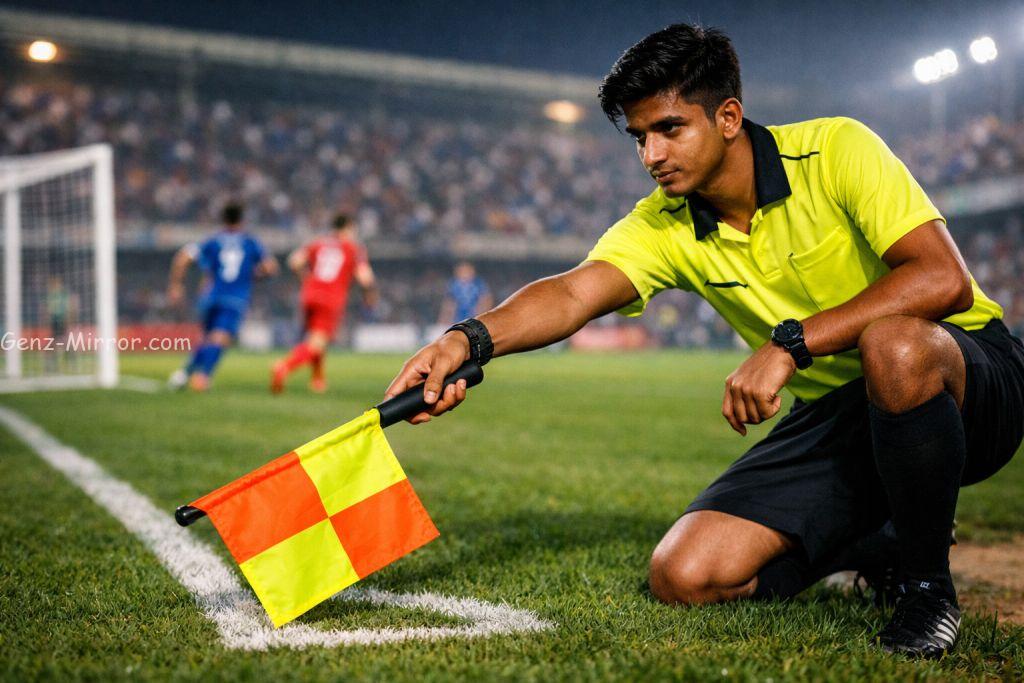
When the ball crosses the goal line, the linesman must quickly distinguish between a goal kick and a corner kick. If the attacking team touched the ball last, the assistant referee stands in line with the goal area and points the flag horizontally toward the goal box, signaling a goal kick. Conversely, if the defending team knocked the ball out, the official sprints directly to the corner flag and points the assistant referee flag downward at the corner arc, indicating a corner kick restart.
Identifying Hidden Fouls and Substitutions
Modern football matches are highly physical, and infractions frequently occur completely outside the central field of vision of the main referee. When a foul or act of violent misconduct happens directly in front of the touchline, the assistant referee does not simply point the flag. Instead, they raise the flag vertically and give it a slight, deliberate wave back and forth. This active waving motion immediately informs the center referee that an actionable foul has been spotted.
Furthermore, the assistant referee flag plays a critical administrative role during player substitutions. When a team requests a tactical change, the linesman stands at the halfway line during a natural stoppage in play and holds the flag horizontally over their head with both hands, creating a distinct frame. This structural signal tells the center referee to pause the restart until the departing player leaves the pitch and the young substitute safely steps onto the field.
soccer linesman signals , football match officials , assistant referee signals , offside flag rule , Vixen assistant referee flags
Embracing the Global Passion for Officiating
Officiating is a beautiful art form that demands supreme athleticism, rapid analytical thinking, and mental fortitude. Across the world, from international stadiums to grass-roots football academies, the assistant referee flag remains a universal symbol of truth and sportsmanship. By understanding the deep technical mechanics behind every wave and angle of the flag, fans can transition from casual observers to true connoisseurs of the game, appreciating the incredible precision that keeps the world’s most popular sport fair, safe, and thrilling for generations to come.
My Name is Sarath and I have one flag for sale !